

The Stunning Predictive Ability of Andor
A ramble about how season 2 of Andor previewed our current political reality.

Picture a peaceful area. A scenic downtown. A vibrant art scene. A history rooted in an aging industry. Picture this area suddenly inundated by law enforcement. Armed and masked officers. Officers that combs the streets in wide-body vehicles, with an air of entitlement. Picture tension percolating between the officers and the area’s citizens. Picture an incident taking place. Violence. Picture it leading to an increase in the presence of officers. Escalation. More officers. More tension. More violence. Picture—in response—protests. Marches. Demonstrations. A community rallying around each other. Picture these acts of defiance angering the officers so much—as if this was all part of a master plan—that tragedy strikes. . . . Death. Citizens are gunned down. And finally, the people in charge—elected officials—frame the events to the rest of the world in a way that contradicts eye witnesses and what videos are able to capture. . . .
If you’re picturing events that took place in Minnesota the past month, well, you wouldn’t be wrong.
However, if you’re picturing images from season 2 of the TV show Andor, well, you wouldn’t be wrong either.
Through the power of invention, a critical-look at history, and a finger on the pulse of our current political climate, the creators of Andor were able to use the universe of Star Wars to reflect—better yet, predict—much of what’s happening in our country today. The show’s second season (which premiered last spring) centers around an occupation of the planet Ghorman, where the Galactic Empire floods the planet with law enforcement officers and reduces the rights of its citizens until an unconscionable event takes place.
Sound familiar?
It all might sound heavy for a Star Wars show, but Andor’s provocative storytelling and cutting depictions of red-hot themes made it herald by critics and fans alike. I’d argue its the best Star Wars product of the last decade and the epitome of “IYKYK.” However, when it came time to create my Best Entertainment of 2025 list, I left Andor off the official rankings and relegated it to the “The Honorable Mentions” section. It was far from top-of-mind.
However, over the past month, after watching fatal videos, hearing government officials advocate for absolute immunity for federal law enforcement, reading about the harrowing escapades of a 5-year-old, seeing the inexplicable attempts at propaganda, and waking up to news of seemingly avoidable tragedies . . . I couldn’t help but think of Andor.
Okay. I also thought about about the erosion of our inalienable rights, the irrefutable signs of authoritarianism, and the debilitating fear rippling through our country. But Andor took up a lot of my headspace. Its prescience and keen ability to capture the essence of fraught situations were too strong to do away with.
I’ll grant you, when faced with real-life tragedy, it’s a little uncomfy to admit that a lot of your brain energy went to a Star Wars TV show, but when the incomprehensible takes place, turning to fiction for answers is a natural reaction. I mean, federal law enforcement agents killing citizens? Once upon a time, that would’ve sounded fictional or at least something you read about in a history book.
And yet, when I woke up on the Saturday of Alex Pretti’s murder and received The New York Times alert that a citizen had been killed by border protection agents in Minneapolis, I wasn’t reading a history book. I was reading my phone. And it was speaking about an event that took place that morning.
I was stunned. I could barely believe it. Due to the killing of Renée Good, the world was watching Minnesota. Especially Minneapolis. All law enforcement were under a microscope. The day before, hundreds of businesses in Minneapolis and St. Paul closed their doors, and people flooded the streets to protest ICE. To any one with two brain cells, it was paramount for the agents and officers to let tensions simmer before another incident happened.
And yet, the unthinkable occurred.
I had a hard time processing it. Not long after receiving the NYT alert, I found the video of the shooting. I watched it. I may or may not have cried. (Okay. I cried.) And I may or may not have gone to Time Square’s Olive Garden after that because I had dinner plans. (Times are weird.) When the following day came around, I continued to wonder, what kind of world are we living in? And better yet, I wondered, what are we to do next?
I didn’t have clear answers to these questions, and I didn’t quite know how to find answers to them either, and that, more than anything, compelled me to revisit Andor.
Let’s dive deeper into Andor.
In the show, as I alluded to, the Empire cracks down on the planet of Ghorman to invoke violence out of an insurgency, so they can mine the planet for a specific resource. They do this through calculated espionage that makes for intriguing television, but also allows the audience to spend time on Ghorman. You get to meet their citizens, learn about their traditions (their fondness for spiders; their sweet greeting that resembles a quarter-dougie), and understand their history both as it relates to their culture and their distrust of authority.
You get to understand their struggle. You get to understand their plight. But all of this is ground work for the pièce de résistance: the Ghorman Massacre.
In one of the most distressing episodes of television ever, the tension between the people of Ghorman and the imperial militia reaches a fever pitch. The Ghors march into a plaza to protest the military occupation. Chanting. Waving flags. Singing songs. The soldiers respond by surrounding them in the plaza, from all sides, and stoking their rage. The confrontation culminates with untrained and unqualified officers confronting an incensed crowd. And then a shot is fired. And then another. And another. And another until officers are open-firing on the citizens. Some citizens—who may or may not be permitted to carry weapons—return fire, but overwhelmingly, its the depiction of a massacre. Citizens try to escape, only to run into soldiers lined up like a firing squad. These citizens drop like puppets. Citizens drop everywhere. Soldiers fall too. Characters you’ve spent episodes getting to know are gunned downed or thrown across the plaza like a child’s play thing. From all sides, the imperial soldiers fire their blasters. There are explosions, gunshots, and smoke. And it all takes place as the imperial officials watch from on-high like conductors at an orchestra.
. . .
It’s jarring television. Harrowing. Astonishing on all levels. And when it’s over, you can’t believe what you just witnessed.
Yes. The Death Star wipes out a planet in a single shot, and Starkiller Base (who could forget?) takes out multiple planets at once, but Andor (season 2) puts you on the ground floor. It makes it about characters, a specific place, a community you’ve been fictionally living in for multiple episodes. It doesn’t display a tragedy. It makes you feel a tragedy. And a year ago, it felt tapped into our political climate. Nowadays—whether its the suspicious deployment of law enforcement, the deliberate escalation tactics, the use of under-trained officers, the loss of life, or the follow-up attempts at propaganda—it feels reflective of our current political reality.
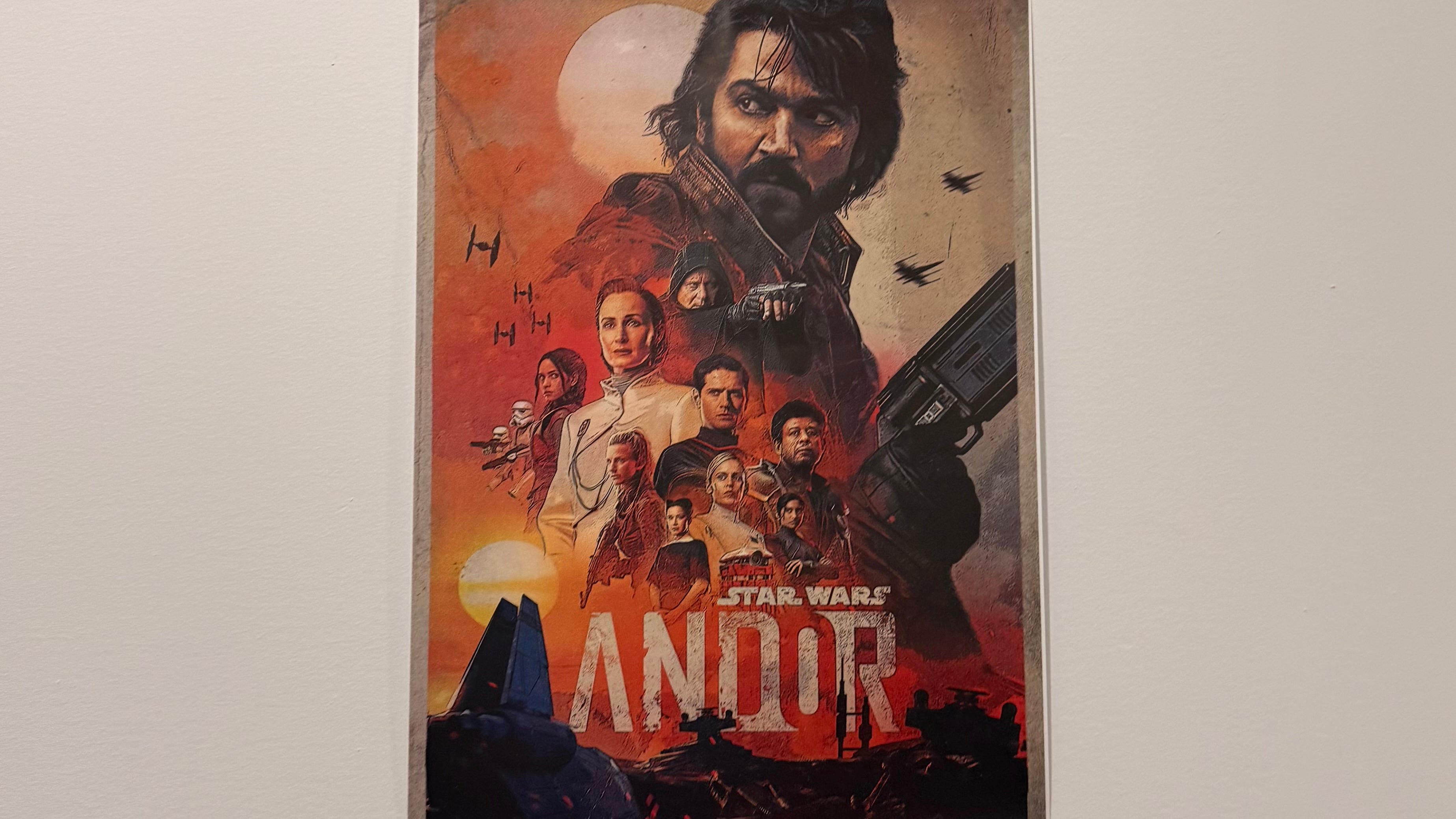
But did rewatching Andor give me the answers I sought?
Well, answers are tough. . . .
***Spoiler alert for all of Star Wars***
The incident on Ghorman is tragic and heartbreaking, but the massacre is a key event that leads to the rebellion. The news of the event is heavily censored by the Empire (sound familiar?), but it still rallies the galaxy’s citizens, evokes sympathy for the Ghors, and is another step to the eventual dismantle of the Empire.
Now, it would be easy to compare that fictional trajectory with our own, but do I think we (in the real world) are on a path to destroying a figurative Death Star due to the events in Minnesota?
Well, to be honest, not exactly. Truthfully, I’m not here to do easy comparisons between the Galactic Empire and our current administration, even if Stephen Miller’s rhetoric evokes Emperor Palpatine and Donald Trump once famously depicted himself as a Sith Lord.


No. That wouldn’t work because there’s no figurative Death Star for us to focus our time and energy on. There’s no farm-boy who’s destined to wield super natural abilities and cleanse the world of darkness. There’s no Han Solo. There’s no Leia. There’s just us in the space that we have here. And in this space, in this country, anything worthwhile is long and hard and difficult to come by. C-3PO isn’t walking though that door.
But if there’s one similarity I don’t mind pointing out, it’s the one thing that is prominent in both this galaxy and the galaxy far far away, and that’s the unbending, relentless power of hope.
Hope.
Hope is something that can’t be taken away and only becomes more valuable when it is infringed upon. If you’re wishing for a better world or for change to come, it starts with hope, and few entertainment properties have captured that idea better than Star Wars.
Oddly enough, the time Star Wars captured the idea the best wasn’t in Episode IV – A New Hope. It’s actually in the delivery of a manifesto at the end of season 1 of Andor. A freedom fighter, who appears earlier in the season, drafts it while on a dangerous mission to put a dent in the Empire’s finances.
I shared the content of the manifesto below:
There will be times when the struggle seems impossible. I know this already. Alone, unsure, dwarfed by the scale of the enemy. Remember this: Freedom is a pure idea. It occurs spontaneously and without instruction.
Random acts of insurrection are occurring constantly throughout the galaxy. There are whole armies, battalions that have no idea that they’ve already enlisted in the cause. Remember that the frontier of the Rebellion is everywhere. And even the smallest act of insurrection pushes our lines forward.
And then remember this: The Imperial need for control is so desperate because it is so unnatural. Tyranny requires constant effort. It breaks, it leaks. Authority is brittle. Oppression is the mask of fear.
And know this: the day will come when all these skirmishes and battles, these moments of defiance will have flooded the banks of the Empire’s authority and then there will be one too many. One single thing will break the siege.
Remember this. Try.
I implore you to watch all of Andor, as the show is filled with a number of worthwhile speeches, but I’ll repeat the final word of this one here: Try.
The message isn’t “do this one thing and everything will work out.” It’s to be tenacious. Relentless. It’s to protest. Vote. Have uncomfortable conversations. Share memes. Create art. Call your senators. Donate to causes. Go on strike. Talk to your friends. Look out for your mental health. Write substack essays!
The message is to do everything. Do what you can. Try. And don’t lose hope.
You never know what will be the tipping or turning point.
Now, I’m far from any political expert or community organizer, so recommending true action is far from my strong suit, but I fundamentally believe that people have the power to change the world, and it starts with people believing they can and utilizing that power to take action. History is paved with communities coming together, doing what they can, and making the unthinkable happen. For the better. And we can be a part of that history.
I mean, Andor does a masterful job of depicting the horrors of imperialistic rule, showcasing authorities using armed officers on their constituents to strengthen their power, and portraying the devastating incidents that can occur under fascism. Unquestionably, the lows of Andor are quite low. But as a part of the greater Star Wars story, Andor also serves the purpose of showing how hope can be weaponized to overcome anything.
“One single thing will break the siege.”
So, if returning to Andor provided me with any answers, it’s that. That no matter how bleak things get, you must hold onto hope, have it power your actions, and use those actions to change the world.
Like me, you might end up just writing an essay about Star Wars. But you never know. You could end up changing the galaxy.
One can only hope.
Great piece! Might have to give Andor a shot....though, how approachable is it for someone with minimal Star Wars experience?